


NEPA Review Levels at a Glance

Most projects that use federal funding or need a federal permit go through one of three levels of review under the National Environmental Policy Act (NEPA): a Categorical Exclusion (CE), an Environmental Assessment (EA), or an Environmental Impact Statement (EIS). The level depends on how likely the project is to have significant environmental effects, and it sets your documentation, schedule, and cost.
NEPA Review Levels Compared
Categorical Exclusion (CE) | |||
When it applies | The action falls in a category the agency has found does not normally have significant effects, and no extraordinary circumstances are present | Effects are uncertain, or the action is not covered by a CE | Significant environmental effects are likely or reasonably foreseeable |
Typical examples | Fiber installed in existing road or utility rights-of-way, small equipment on existing structures, minor upgrades | New fiber routes across undisturbed land, new towers, projects near wetlands or sensitive species | Large new infrastructure with major land, water, or community effects |
Main document | CE determination or checklist with supporting reviews | Concise EA, then a Finding of No Significant Impact (FONSI) or a decision to prepare an EIS | Notice of Intent, draft and final EIS, Record of Decision (ROD) |
Page limit (statutory) | None set | 75 pages | 150 pages, or 300 for extraordinarily complex projects |
Deadline (statutory) | None set | 1 year | 2 years |
Public involvement | Usually none required | Set by each agency's procedures | Public notice and comment on the agency's intent to prepare an EIS; further comment set by agency procedures |
Relative effort | Lowest | Moderate | Highest |
Page limits and deadlines come from the 2023 NEPA amendments in the Fiscal Responsibility Act. Appendices and citations generally do not count toward page limits. Examples are illustrative only; the lead agency decides the level for each project. Sources: National Law Review, Ashurst Perkins Coie.
Typical steps
Every NEPA review ends in a CE, a FONSI or a Record of Decision
Typical steps; each lead agency sets its own procedures
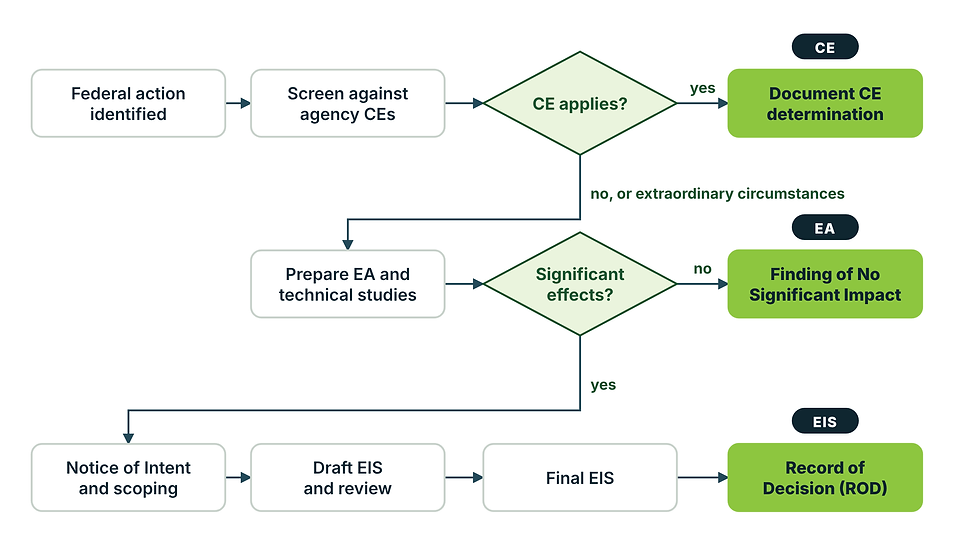
Every project starts with a CE screen. An EA is prepared when no CE fits or extraordinary circumstances apply, and an EIS follows only if the EA finds significant effects or they are expected from the start.
What determines the level
The lead federal agency (for example NTIA, FCC, USACE, or FHWA) decides the level using its own NEPA procedures. These questions usually decide it:
Is there a federal action? Federal funding, a federal permit, or work on federal land triggers NEPA.
Does a CE cover it? Each agency keeps its own list, and agencies may now adopt another agency's CEs.
Are there extraordinary circumstances? Effects on threatened or endangered species, wetlands and waters, historic properties, tribal resources, or floodplains can push a CE up to an EA.
How sensitive is the setting? Ground disturbance in undisturbed areas, new structures, and longer routes raise the level of review.
Other reviews often run alongside NEPA at any level, including Section 7 (Endangered Species Act), Section 106 (National Historic Preservation Act), and Section 404 (Clean Water Act).
How WBE helps
WBE identifies the likely review level early, prepares CE documentation, EAs, and supporting technical studies, and coordinates the consultations that run alongside NEPA.
A note on recent changes: The Council on Environmental Quality removed its government-wide NEPA regulations in 2025, and each federal agency now follows its own updated procedures. Requirements for public comment, CEs, and extraordinary circumstances vary by agency, so confirm the current rules with the lead agency for your project. This guide is general information, not legal advice.
Comments